Friday, March 18, 2016

Ko Samui, Thailand: Good for a half day…not much more…


Ko Samui is becoming one of Thailand’s “go to” beach resort areas. It is one of the largest islands off the Thai coast and we had half a day there.


Frankly, half a day was enough for us. Although the beaches are among the most beautiful we have seen anywhere, the entire island appears to be overrun with schlocky tourist resorts, tourist bars, tourist restaurants, tourist dives, tourist ____ (insert your own word here).

Our half day was an opportunity to drive through this stuff to get to an adult amusement park (cheesy as it turned out to be) and a look at a large Buddha statue that must have once been really something to see.

We anchored offshore about three miles out. Normally we would have anchored about a half mule out, but the Royal Thai Navy was on maneuvers and we were held much further offshore. What we had expected to be a ten-minute tender ride, turned into a half-hour ride each way.

Once ashore, we piled into mini-vans for the half-hour ride out to the Elephant Trek Park (“Funny Day Safari” – can you believe it!!). Along the way we were treated to a continuous strip of the aforementioned list of tourist stuff. Personally, we were disappointed since we had been told that Ko Samui was such a great place for locals and visitors to vacation. Think of the Florida Keys and Key West on steroids…

The Funny Day Safari was interesting. It appears to be a farm that has been converted to the adult version of state fair pony rides with elephants instead of ponies. Each elephant is mounted by a trainer and has a plank seat for two people. Several of our traveling companions had some issues trying to mount the seat and get “belted” in. The seat belt was actually an iron rod that was placed in front of the seat similar to that of a roller coaster.

Unfortunately, Bonnie was one of those unable to mount the seat because it was both too high and there was nothing to grab on to to pull oneself up. Yours truly had the seat to himself and off we went. My elephant was a 15-year-old named Tonlay and her trainer was Thom (silent “H”). The “trek” was a well-worn path through the fields that Thom and Tonlay had obviously been doing for years.

After I got into the seat and get anchored by the iron rod, Tonlay started moving. What followed was about 30 seconds of abject terror (on my part) coupled with about 15 minutes of gentle rocking as we moved slowly around the trail.


We made it back to the loading point without further incident and I unbolted, returned to terra firma, told Tonlay what a good girl she was, tipped Thom, and we proceeded with the rest of the group to the “Baby Elephant Show.” The show was 15-20 minutes of circus-like stuff by two young elephants (3 years and 5 years). That was followed by the “Monkey Show.” This was another 15 minutes or so of a demonstration showing how they train macaque monkeys to climb trees (not much training required there) and pick coconuts for export. Thailand is the world’s largest exporter of coconuts and coconut products.

When the monkey climbs the tree, he has been taught to twist the coconut so that it becomes detached from its root and falls to the ground where the trainer picks it up and bags it. We are told that the monkeys can pick from 600 to 1000 coconuts a day, whereas when men are hired to do the same job they can only produce from 200-300 coconuts a day. Men require time to recover from climbing trees, they need a smoke break, they need a bathroom break, they need lunch, they need time to re-adjust their garments, etc..Monkeys do not have a strong union and can thus be made to work up to ten-hour days with no long breaks.

I have purposely not included any pictures of the animal shows here. As we were riding back to the tender dock, I got to thinking about how the animals live. I believe they are treated OK - after all, these folks must make their living from these shows. However, I also saw signs of stress among the animals. I am no expert on animal behavior (except for my own in my misspent youth...), but the pacing, head-shaking, and constant reaching for visitors, it seems to me that they really need alone time and room to roam. Enough of my rant.

We left the “farm” to go to the coast and view the “Big Buddha.” No joke, it is officially named the Big Buddha since it is no longer a consecrated worship site. The statue sits on a high platform with a long set of stairs that allowed the faithful to work their way up to Nirvana. The view from the top is great, but the heat precluded any of us from making that trek.

 As we entered the area where the Big Buddha is located, all we saw were shops and restaurants.

The temple itself is rather interesting. If it had not been so hot and sticky, I would have tried for Nirvana. As it was, we bought our obligatory refrigerator magnet and opted for the shade of one of the stores.

We took a few pictures and mostly strayed through the gift shops, tee-shirt shops, beach stuff shops, and food stands until our half-hour of free time was up. Then it was back in the van for the trip back to the tender dock, tender out to the ship, and up anchor to begin the next leg to Singapore.

We know that Singapore will be much more exciting and we plan some better adventures there. We will have two days there, so stay tuned…

Thursday, March 17, 2016

Bangkok: the absolute definition of traffic!

We have two days in Bangkok. Last year we got pretty much “templed out” after two days of visiting temples, monuments and palaces. This year we decided to sort of lay back and try to enjoy the city a little more.
Just a reminder of where Bangkok is located.

A few of our cruise friends had been telling us about the great deals and wonderful selections they have been getting for custom made clothing in Bangkok. While Hong Kong and Saigon are also well-known for custom tailoring, the general consensus among those with whom we have discussed the issue agree that Bangkok is at least as good quality-wise and a lot better price-wise. Sooo…we took the plunge and a recommendation from a couple whose clothes we had been admiring on formal nights. We had the shore concierge call Tony’s Fashion House to arrange for them to pick us up at the ship and take us directly to the store.

The mini-van ride to the shop was interesting. We had forgotten just how much traffic there is in Bangkok. It makes Saigon and Hong Kong seem almost peaceful by comparison.It took us about a half-hour to get the roughly 7 KM (about 4 miles) from the ship to the shop. The amazing thing about Bangkok traffic is that the different types of conveyances – cars, trucks, busses, tuk-tuks, pedestrians, etc. – all seem to just flow around each other like water around rocks in a streambed. That amazing ability to move at seemingly high speeds and not hit one another is coupled with an almost total lack of horn-blowing. Later in the day we were to learn why that is unique to Thailand – especially so in a large metropolis like Bangkok.

As we entered the tailor shop, we were greeted by “Max,” our salesman/host. After the usual cordial preliminaries, we got down to business. Bonnie wanted to look for a jacket to wear on a formal night and a jacket that could be worn in more casual settings. She also wanted me to get a new formal dinner jacket.
After looking through hundreds of bolts of fabric and several books of designs, we managed to come up for air long enough to pick two fabrics for Bonnie and one for me. Hers are a red raw silk for the less formal jacket and a black and gold polished silk jacket for more formal occasions. I found a beautiful silver silk brocade material for my dinner jacket.

After working through the pricing, we settled on a package for all three jackets. Max asked us to return later that afternoon for a second fitting. They will pick us up at the ship again and return us.

In the meantime, we asked to be taken to the eight-story Central World Shopping Mall in the heart of Bangkok so we could look around a bit and be closer to several outdoor markets and food outlets. The Mall is not one which we would use for shopping since it looks like every other mall in the world and has many of the same stores, but it is a convenient drop-off and pick-up location.

They do have two entire floors of restaurants. We opted to stop at Nara, a Thai restaurant that was full of local people. We had a great lunch of Thai dumplings and a mixed seafood platter with a beer each for the munificent sum of about $27 including an obligatory 10% tip. Such a deal!

After lunch we wandered along several of the streets near the mall and saw genuine designer shirts on sale for only US$5 and Rollex watches for only US$7. Wow! These had to be much better than even the really expensive gold watches because they had an extra "L" in the name...

Since it was rather warm (35°C, that’s 97°F) and since we really didn’t need any more “stuff” we worked our way back to the mall and window-shopped until the ship’s shuttle bus came and took us back to wait for our next pick-up from Tony's for the second fitting.

Promptly at 5:30 the van from Tony’s showed up and whisked us away for our final fitting. Actually, whisked is not exactly how we went. The traffic was bumper to bumper to bumper all the way from the pier to the store.

While we were back at Tony’s getting our fitting, we mentioned the lack of cacophony to Singh, one of the tailors. He explained that since Thailand is primarily a Buddhist society, blowing one’s horn at another person is a sign of disrespect and is not tolerated among polite people. Another interesting aspect of East Asian culture among the Thai. we calculated that all day we spent about four hours traveling back and forth and about two hours in the shop.
 Yours truly getting fitted.
 Our tailoring "crew": Yui, Max and Singh.
Bonnie getting fitted for one of her jackets.
 Bonnie getting fitted for the other jacket.

Finally, having been fitted and re-fitted, we were escorted back to the ship for dinner and an early to bed.

The next morning we were up and out fairly early. We tried to make a deal for a taxi to take us from the pier to the Tourist Boat dock, but they thought they had a captive audience and we walked away from his offer of US$30 for the ride. We took the ship’s shuttle to the same Central World Shopping Mall as yesterday, but this time we walked straight over to the Bangkok Train Service (BTS) main station and for about 50¢ each we rode the train five stops to the tourist boat dock on the Chao Praya River. Ha – thirty dollars, indeed!
The tourist boat took about 45 minutes to get from the main dock in the south to the northern end of its range and about the same time back.

The train ride was wonderfully smooth and just like the one in Disney World – NOT! Similar, but much more packed with locals going about their daily chores. A short walk to the dock and a short wait for the tourist boat (about $1.35 each) for the 45-minute ride up the river passing most of the temple and high end hotel sites. Another $1.35 from the ride back and then the highlight of the morning: a Bangkok taxi ride from the boat dock back to the Silver Whisper’s pier. Talk about Mr. Toad’s Wild Ride (yet another Disney reference…)! Let’s see, a driver with very limited English, two passengers with absolutely no Thai, traffic that makes one hang on to whatever is handy, and only about four hours left to get back to the ship before it sails to the next port. Talk about a fun day!

When we got back to the ship (after a fast, but relatively uneventful ride), our custom-made jackets were waiting for us in the room. We tried them on and were quite pleased that they fit perfectly. I will post a picture of us in the finished products on a future entry.

Another adventure chalked up to success.

Tomorrow we are anchored off the resort island of Ko Samui, Thailand for a half day. Stay tuned as we take off on an elephant trek…

Tuesday, March 15, 2016

Saigon and the Mekong Delta: two very different worlds


We have found Vietnam to be quite different depending upon where you happen to be in the country. Last year we started in the middle of the country in Da Nang. In that area, nearby the Central Highlands, there were still many relics of the war and the economy seemed to be centered on tourism and agriculture. This year we began in the north and found a totally different outlook among the people and in what saw and we experienced.
We are now in the south once again – Saigon was on last year’s itinerary as well. However, we want to see yet another facet of this exceptional country.
Yesterday we took a mini-van to the Mekong Delta and boarded a small longboat for a semi-private tour of one of the world’s most fascinating locations: the Mekong delta. it is about a two-hour van ride through small settlements and a short stretch of “highway” to get from central Saigon to the delta. We went to the village of Cai Be (kie bay).
 
Cai Be is an area visited frequently by tourists due to its location with respect to Saigon. The population is nominally about 5000-7000, many of whom work on the river either as farmers or tour boat operators/guides. We were fortunate to have had several mini-vans from the ship, but each van only took six passengers, a driver, and a guide. Thus, a semi-private tour.

Our first impression upon seeing the longboat and realizing that we were committed for the next few hours was a feeling of “what have got myself into?” Our boat “captain” was a very pleasant young lady, who spoke not a word of English, but who spoke excellent “River.”
 
She handled that longboat as if it had grown up around her. Several times we thought that an errant branch or clod of floating debris would hamper us, but she very skillfully maneuvered around everything – including larger boats wakes… Our only real problem was that the chair seats in the boat were designed for Vietnamese bottoms, not western bottoms, and after a while we longed to just stand up.

We left the dock and motored up the Can Be branch of the delta to a small canal. The canal was almost hidden from view until we were on top of it. Several of us thought she was deliberately steering for the river back – then “open sesame!” As we wended our way along the canal, we were able to observe the locals at their daily chores. Interestingly, most homes had electricity and running water – sort of. For many, it was only cold water that had to be had-pumped and heated on a wood or other fossil-fuel stove.

We stopped about halfway through the ride to visit a local crafts market and local candy/snack-making “factory.” We were treated to Vietnamese rice popcorn handmade over a kiln-like apparatus that has to be from the middle ages. We also saw the process of making coconut candy from the raw coconut and the pressed juice that is boiled and flavored. Finally, we were treated to a lesson in making rice crepes. After the cooking demonstrations we had a few minutes to wander the local handicraft shop for our obligatory magnets, etc..

One stop on the culinary trip was so interesting that I want to give it more detail. We were shown how the locals boil up rice to make a high-alcohol juice that resembles sake or vodka, but with a much higher alcohol content. They then add a “secret ingredient” and let it ferment for about a year before it is pronounced drinkable. This concoction is only for local men and male tourists, but women tourists were also allowed to sample it. Not many women chose to do so after the secret ingredient was revealed to be snake. Not snake meat or snake skin, but whole live snakes. They are put in to brew while still alive and then left to …well, you know.
 
We saw a number of large jugs lined up with all types and sizes of snakes within the, by now, cloudy liquid. This trove included a full python with its hood puffed all the way out.
 
Yes, yours truly had to try it. Surprisingly, it tasted a little like Italian Grappa… After I had my two sips, I did indeed feel much more virile and manly – or perhaps it was just the exceptional alcohol content…

After our adventure in exotic cuisine we stopped for a snack at one of the local landmarks: a house built in 1838 and in continuous ownership and use by the same family since that time – until the end of the war when it came into government ownership. To their credit, the government officials kept it as it was and is has made a list of Vietnamese heritage sites.
 
Most everything takes place in the canal or on the river, similar to what we had seen in the Amazon several years ago: playing, moving from one place to another, bathing, etc. It is the etc. that gave us pause later on when we stopped for a local snack.
 
We had a go at clean happy rooms (remember that expression from our guide in Hanoi?) and the aforementioned snack before re-loading the longboat for the trip back to Cai Be village. Bonnie and I saw how the dishes and silverware were being washed, so she opted for just a beer and I had a beer and a couple of finger-food spring rolls that had been cooked.
 
After another long, long mini-van ride back to Saigon we re-boarded the Silver Whisper, had a sandwich and Champagne in the suite and crashed for another day.

The next morning we were up and out early for a panoramic tour of Saigon. Last year when we were here, we used Da Nang as the jumping off point for our side trip to Angkor Wat in Cambodia. We then returned to Saigon to rejoin the ship, but we only had a short day, so we went to the big market and did some shopping. This time we still only have a short day the second day, but we opted to spend it on this guided trip – mistake!

We were on a regular tour bus with 23 other people, some of whom, it was determined very quickly, had no concept of “5 minutes” or 10 minutes” or “please be on time.” We also found that our guide’s English was very good if you could listen and concentrate on what he was saying. The downside was that almost everywhere we went there were other tour groups, hard surfaces in enclosed spaces (read: “echoes”). We know that the ship has the “Whispervox” mini-earpiece units because they used them in other ports. Why they did not send them out here is beyond us. After only a few minutes of trying to listen to our guide and block out the other noises and guides, a number of us gave up and just wandered the National Museum, the Market, and the Chinese Temple. Therefore, I have not much to report on, but I did get a few interesting pictures.
That evening we took part in an adventure of a different sort: we were part of a small group of folks who got together to throw a gala dinner for the crew. We had heard that a group of people we know did this same thing last year and we asked if they would include us this year.

It was not only a lot of fun turning the tables on the staff, but it was a great way to show our appreciation for the hard work they do daily to keep us happy, well-fed, and with spotlessly clean rooms and public spaces. The officers and crew were also quite appreciative of the fact that paying passengers would take the time to serve them – even if only for one meal. We can’t wait to to is again on another cruise.

We were shown to the officers’ mess where the ship’s executive chef had laid out an extravagant spread of food not normally available to the crew: shrimp, chicken  in various sauces, salads, pastries, cheeses, chef-made pastas, and the crown jewel: roast suckling pig. Yours truly did the honors carving the pig. Miss Bonnie was the shrimp, calamari, and vegetable mistress.
Nothin's says lovin' like a baby pig's head...
The mistress of the shrimp and calamari.
Can't cut a pig with a dull knife.
 OK...which end goes over the fence last...I want to save that for one of my favorite people...
 
Tomorrow is a sea day followed by two days in Bangkok, Thailand. We have no tours or other events planned, so we will try Bangkok on our own. Stay tuned…

Friday, March 11, 2016

There is no North and South Vietnam…there is only Vietnam.


Many people may blanch at the title of this post, but our two days in Ha Long Bay and Hanoi proved to us that Vietnam has irrevocably changed since the so-called Vietnamese War. I say so-called because from their side, it was the American War. Our guide, the charming and affable Lieu (Lee-oo), made it clear that we were in a Communist country that was experiencing a market economy. Based on our experience, we believe one would be hard-pressed to find  animosity toward America or Americans in Hanoi or in the old north.

We are still in the north and the weather is still very cool and cloudy.
Hanoi is a huge city and the central portion is quite spread out.
Our guide, Ngyuen Dien Lieu, "Lieu."

Put in historical perspective, consider the following:

For thousands of years the Vietnamese were fiercely independent and apart from most other southeast Asian peoples.
  • They were conquered by the Chinese in the ninth century – that rule lasted for over 1000 years.
  • The French took over from the Chinese in the mid-nineteenth century – that “protectorate” lasted about 100 years (roughly late 1950s).
  • The Americans were there in a war that lasted a mere ten years (roughly 1963-1973).
Given that our presence as combatants was a mere blink of an eye compared to the French and that the French occupation was an annoyance compared to the Chinese, it becomes more clear that the Vietnamese have no use and do not trust their nearest neighbor to the north, tolerate the French heritage, and love Americans. Another huge factor is that there are over 92 million Vietnamese in an area half the size of Texas (just slightly smaller than California). Of these over 75% were born after the cessation of the conflict in the 1970s and over 25% of the population is under the age of 25.

OK, enough about the demographics and politics. We were in Saigon (Ho Chi Minh City (HCMC)) last year and were not sure what to expect this year. Having a day in Hanoi and Ha Long was a very good start. Our first day was a long one.

Hanoi is a little over 100 miles from Ha Long. If there were interstate highways in Vietnam, we could probably make the trip in a little less than two hours. Unfortunately, most of the roads are much less than highways in Vietnam.

 We were up at 6:00 and in a mini-van for the three-hour + trip from Ha Long City to Hanoi. Driving in Vietnam is akin to a contact sport – except for the contact part. They use four implements to propel their vehicles: the gas pedal; the clutch (remember the clutch???) the brake pedal; the horn. The gas, clutch and brake are used in the usual way, but the horn is special.

When starting out the horn is blown hard and loud to let others know you are there. When moving in traffic the horn is blown at every other vehicle to let them know you are there and will probably be passing them –to the left, to the right, down the center line (if one exists), on the shoulder, wherever… The horn is also used to alert the myriad of motorcycles, mopeds, bicycles, etc. that you are behind them and want them to move out of the way. Although most vehicles have rear-view mirrors, they are universally distained in favor of listening for a horn that may be too close.

We found it fascinating at first. The fascination turned to fear when we realized that we were only one vehicle of many to all the other vehicles. The fear turned to resignation when we realized that we would not be getting any little catnaps on the long drive into the city.

Fortunately, our guide was a good one and the first thing he told us was that there would be a stop about halfway for the “happy room”. The rest stop was at a rehabilitation and training facility for people who were the victims of Agent Orange or had suffered birth defects of any nature. They live, work and play at the complex. We saw silk embroidery, clothing-making, and other local crafts being taught and practiced and we had an opportunity to make this a shopping stop, but the six of us in the van wanted to get to Hanoi.

Hanoi is a giant city, but only the second largest in Vietnam with just over seven million inhabitants (by the legal census; no one really knows the actual number). Saigon is the largest city.
This map shows the relative locations of the sites we visited.

We wound our way through the narrow streets and broad boulevards to the center of the city and our first stop: Lake Hoan Kiem and its shrine. Vietnam has no official state religion or even a generally recognized nation religion (such as Catholicism in the Philippines). Lieu explained that most people have a belief in a divine being, similar to many eastern religions, but they tend to worship in their own individual ways. The shrine in the lake commemorates an ancient emperor who was said to have saved the country from an invasion. That story, as in many handed down in oral tradition, has many interpretations and embellishments, but the temple itself was gorgeous.
 The main entrance to the temple.
On the bridge over the lake.

After our temple visit, we walked several blocks to a section of the old quarter (pre-French) that we would call an “eating street” in most other locations. The walk itself was an adventure. First we had to make sure that we were all grouped closely together. Then we waited for Lieu to say “Now!” Then we proceeded to leave the relative safety of the curb and begin walking into traffic. The trick, we were told, was to keep your eyes front, walk at a steady pace – no halting or running, and just look as if you know exactly what you are doing. By George, it worked! We are still alive and well and obviously have lived to tell the tale.
We left the curb just after the van on the right edge of the picture passed us. Talk about a leap of faith...we just moved out as a group and floated through the sea of mopeds, motorcycles, bicycles, and vehicles.

The “eating” street was narrow and lined with stalls and shops side-by-side serving almost as many different foods as shops. Several of us wanted to try a few things, but if we had sat on the tiny and very low stools available, we might not have gotten back up… Then of course, there’s this e. coli. thing… oh well.
A typical eating shop.
The lady is preparing the traditional bowl of Pho...yum,yum...

After our tour of the old section we went for our real lunch. It was a grand Vietnamese seven course affair at one of Hanoi’s oldest “good” establishment, Ly Club. We had “Pho”, spring rolls, stir-fry, stew, grill, and steamed fragrant rice. All this followed by several slices of fresh local fruit for dessert. One thing about the Vietnamese national dish, “Pho”. It is pronounced “fa” with a dropped and rising end tone. That is important because if you do not impart the correct tonality to the word, then you might be asking for a “street girl.” Vietnamese is a tonal language, even more so than Chinese. There are four tones in Mandarin and Cantonese, but there are six tones  in Vietnamese. Vietnamese is one of the ten most difficult languages to learn of all the world’s languages.

After lunch we drove to another temple. This time it turned out that the temple was the original school in Vietnam and was actually built as a Confucian Temple. The day we were there we were fortunate that high-school graduates were present to have their pictures at this school/shrine/temple. In addition, an assembly of primary school children (I guess at their ages of between 6 and 8) were receiving a lesson as well. I have a soft spot for kids and these kids were just achingly cute and friendly. As we walked past them they would look up and smile and wave.


I don't think that the pictures above really need any captions.
 
We pulled ourselves away from the school and took a short walk to the Vietnam Fine Arts Museum. The museum is housed in a former girls’ school dormitory built during the French occupation. It is one of Vietnam’s oldest and best museums. It contains artifacts, crafts, and artwork of all types dating back to the eleventh century.

To cap off the day, we made our final stop in Hanoi to visit Uncle Ho. Ho Chi Minh is considered the father of his country in a fashion similar to that of George Washington in America. He was responsible for re-activating Vietnamese pride and patriotism in the waning days of the French occupation and led the Vietnamese to finally oust them for good in the mid-1950s. I won’t go into all of the politics and intrigues that led to the American involvement in the 60s and early 70s. Suffice it to say that Ho Chi Minh was alive and leading his people up until his death in the early 1960s.

We saw the presidential palace. It is a grand structure in the traditional architecture of the French Colonial period. Ho distained the grandiose and had a simple stilt house erected behind the palace that he used for his living quarters. During his tenure the palace was only used for state occasions.

The Presidential Palace.
The Stilt House. If you look carefully at the bluish structure to the left of the stilt house, you will see that it appears to be a dirt covered mound. That was Ho Chi Minh's personal bomb shelter. We were told it was never used.

The One-pillar Pagoda.

As we moved from the area of the Presidential Palace and the Stilt House, Lieu gave us more background on Uncle Ho and we were led to the “One Pillar Pagoda.” The pagoda was built to emulate the lotus flower; thus, the single large pillar supporting the shrine itself. The lotus is the symbol of Hanoi.

We continued our walk around the grounds and wound up viewing the massive mausoleum housing his embalmed and  mummified remains. We could not get into the mausoleum for a viewing, but we didn't mind.

Back to the vans for the drive home and, perhaps, a little nap during the drive. Not to be. as night fell and we began the drive back, we realized that for many of the mopeds and motorcycles, the use of headlights and taillights was optional. For other motor vehicles, the use of high beams by oncoming traffic appeared to be mandatory. No catnaps on the way home either.

We made it to the dock a little after eight in the evening and realized that we still had a 20-30 minute tender ride back to the ship anchored in the harbor. We stumbled back to our suite a little before nine and managed to order a pizza and Champagne for dinner. Not a bad end to a fabulous day!
As you can see from the map, we only scratched the surface of the Ha Long Bay area. We could go back and spend a few days on one of the cruise boats that ply these waters exclusively. There are bay cruises that go for several days. Perhaps, on a return trip to the area...

The next morning we again rose early and prepared for a morning sail on one of Ha Long Bay’s famous junks (that’s a type of boat, not a commentary on the upkeep of the vessel…).

During the night, the Captain had a barge pulled up to the tender door and about a dozen of the Has Long Bay junks were pulled up to accept passengers. It was easy to walk off the tender platform, on to the barge deck, and then on to the junk. We were on a junk that could probably hold over 100 passengers (if they were locals) and we only had about 25 people on each junk.
 We went from the tender door to the barge to the junk.
 This is typical of the junk.
Our "Captain." I know he looks like he is about 12, but he was actually in his early thirties. Vietnamese, because of their small stature, wiry build, and constant smile, appear to be much younger than they actually are.

We slowly motored out of the harbor and headed for the rocks – figuratively, not literally. Ha Long Bay is teeming with ancient rock formations that are the tops of hills and mountains left from volcanic and tectonic action eons ago. The junks are motorized, but they move slowly and the motors are very quiet – so quiet that after a few minutes one is hardly aware of the background hum. It is almost like being on a sailboat under sail.

One surprise right away was the number of these boats of various sizes that are plying the waters of the Ha Long estuary. It is an estuary in that the area we were in was only from about 15’ to about 35’ deep. We were on the water a total of almost three hours. Each junk had two of our servers from the ship along with treats. The treats were finger sandwiches, cookies and small pastries,  and Bellini cocktails. This was so that no one would be afraid of starving on the trip…

We had seen pictures of the rock formations in Ha Long Bay on various travelogues and in magazine articles, but actually being there and viewing these formations firsthand is different. The only fancy words that come to mind are Wow! and Wow again! I will let most of the pictures speak for themselves.


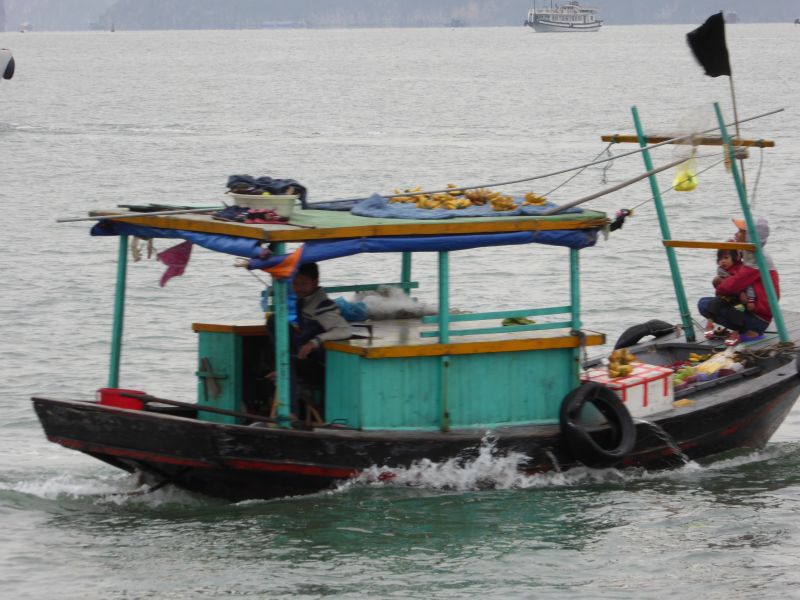
These two pictures are typical of the floating merchants who eke out a living going from boat to boat trying to sell their wares. In this case it was bananas. Others are crafts or other fruits.


 Just to show the disparity among the various vessels plying these waters.
Your intrepid explorers as we glided among the rock formations.
 
Speaking of pictures, we took over 500 shots between us during the two days. What I am publishing is but a small fraction.

We are now on our way south to Saigon for two days.
Stay tuned…